
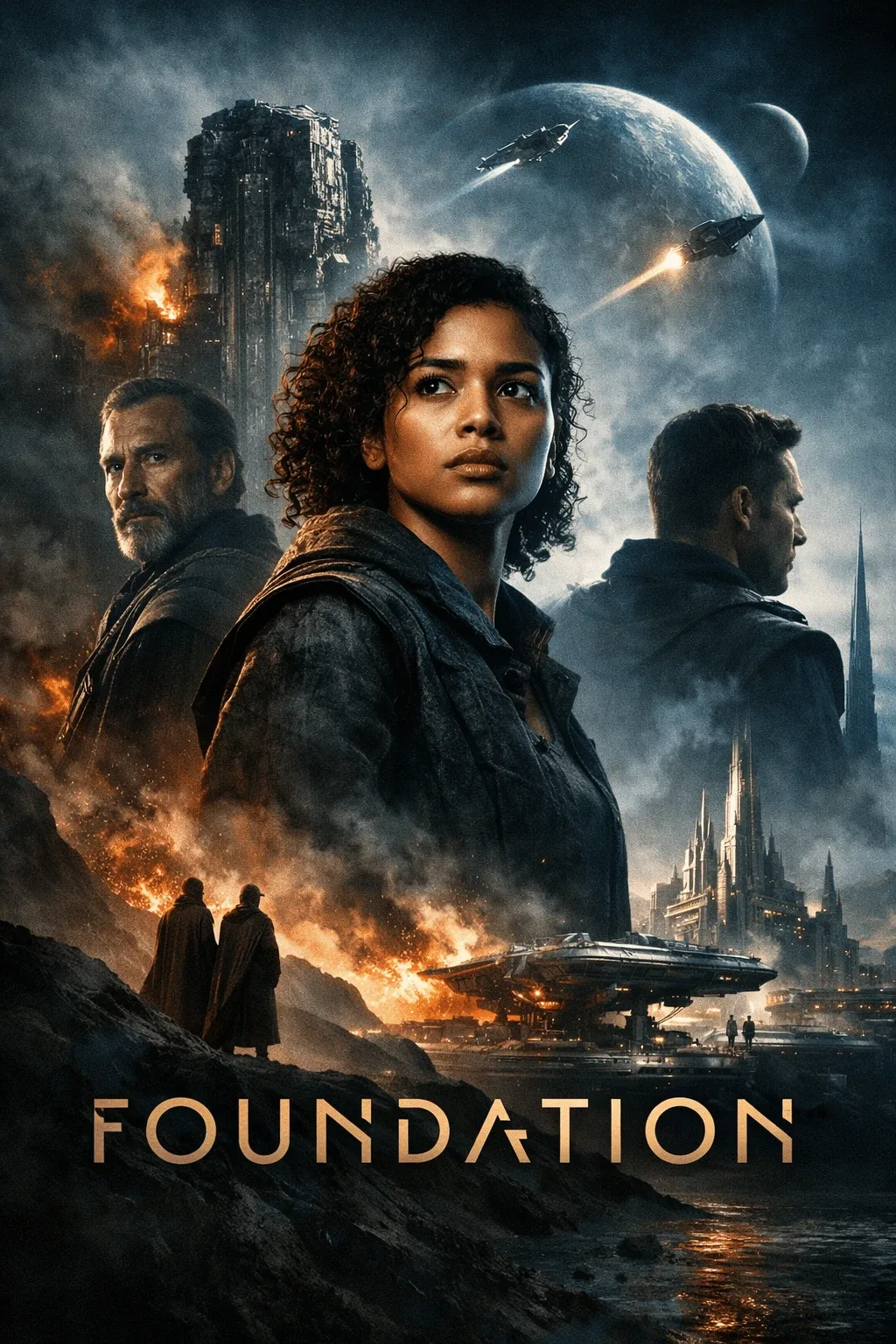
Hello, everyone! How’s everything? Today, I’m excited to share my thoughts on the drama Foundation, which showcases David S. Goyer’s ambitious adaptation of Isaac Asimov’s iconic science fiction series detailing the decline of a galactic empire and humanity’s fight for survival throughout the universe.
Advertisements
The third season debuted on Apple TV+ on July 11, 2025, continuing the grand narrative that began in September 2021. With 10 episodes per season, each lasting around 60 minutes, Foundation stands out as one of the most visually arresting and narratively intricate series currently on television. The ensemble cast includes Jared Harris, Lee Pace, Lou Llobell, and Leah Harvey, crafting an expansive space opera that spans numerous centuries and worlds.
Adapted from Isaac Asimov’s award-winning novels, Foundation follows a group of exiles on their monumental quest to save humanity and restore civilization during the decline of the Galactic Empire. The series delves into themes of power, fate, religion, and the cyclical patterns of civilizations while showcasing some of the most breathtaking visual effects ever created for the small screen.
The Math of Humanity’s Future
In the distant future, mathematician Hari Seldon has created psychohistory, an innovative science that can forecast the futures of large populations. His findings indicate that the formidable Galactic Empire will collapse within 500 years, casting humanity into 30,000 years of darkness. To safeguard knowledge and alleviate this dark period, Seldon sets up two Foundations at opposite ends of the galaxy.
The brilliance of Foundation lies in its multi-faceted storytelling approach. While chronicling the Foundation’s endeavors to preserve civilization, the series also examines the Empire’s decline through the perspective of the genetic dynasty of cloned emperors. Each narrative thread operates on varying timelines, with some characters experiencing decades while others endure for centuries through diverse technological means.
Season 3 introduces The Mule, one of Asimov’s most intriguing villains, a mysterious entity with unparalleled mental abilities who threatens to disrupt Seldon’s meticulously crafted plan. The Mule makes a violent debut in today’s premiere episode, ‘A Song For the End of Everything’, adding a new layer of unpredictability to the series’ exploration of fate versus free will.
Hari Seldon: Jared Harris as the Mathematical Prophet
Jared Harris delivers an outstanding portrayal of Hari Seldon, the psychohistorian whose calculations initiate the entire saga. Harris imbues the character with gravitas and intellectual depth, convincing both his followers and viewers that mathematics can forecast human fate on a galactic scale.
What makes Harris’s performance particularly captivating is his depiction of Seldon’s steadfast belief in his science while revealing the personal toll of carrying such immense knowledge. Seldon understands that billions will suffer during the Empire’s downfall, yet he also knows that his strategy represents humanity’s sole chance for survival. Harris artfully conveys this burden, presenting a character who is both visionary and tragic.
Employing various technological means, Seldon appears throughout different eras, allowing Harris to investigate how the character’s legacy transforms and how his original objectives are perceived by future generations. It’s a complex role that necessitates Harris to embody both a historical figure and a mythical prophet.
Brother Day: Lee Pace’s Despotic Sovereignty
Lee Pace commands attention as Brother Day, the ruling clone of Emperor Cleon I, epitomizing the Empire at its zenith and most paranoid. Pace injects both regal authority and a subtle vulnerability into a character who governs trillions while wrestling with issues of identity and existence.
The 46-year-old actor unveils his